Dept. of Mechanical Engineering Graduate Seminar
PRESENTATION: The study, optimization and data-driven modeling of aeroelastic systems require evaluating their dynamics for large parametric spaces. Obtaining comprehensive datasets of such systems is challenging as a result of the nonlinear and tightly coupled fluid and structural mechanics that govern their behavior. In this research, a cyber-physical platform is developed that enables fast evaluation of the two-way coupled fluid-structure interactions of a plate with a torsional degree of freedom without modification of experimental hardware. The platform is used to evaluate the dynamics of a rigid inverted flag – a promising configuration for aeroelastic wind energy harvesters. The results are validated with experiments performed on a fully-physical system, and the cyber-physical platform is shown to be capable of replicating both static and dynamic aeroelastic instabilities, limit cycle oscillations, and chaotic dynamics. The platform is then leveraged to study the dynamics of the flag for non-linear structural behaviors and varying structural damping. The results show that non-linear structures can be utilized to improve the operational range and harvesting performance of the flag.
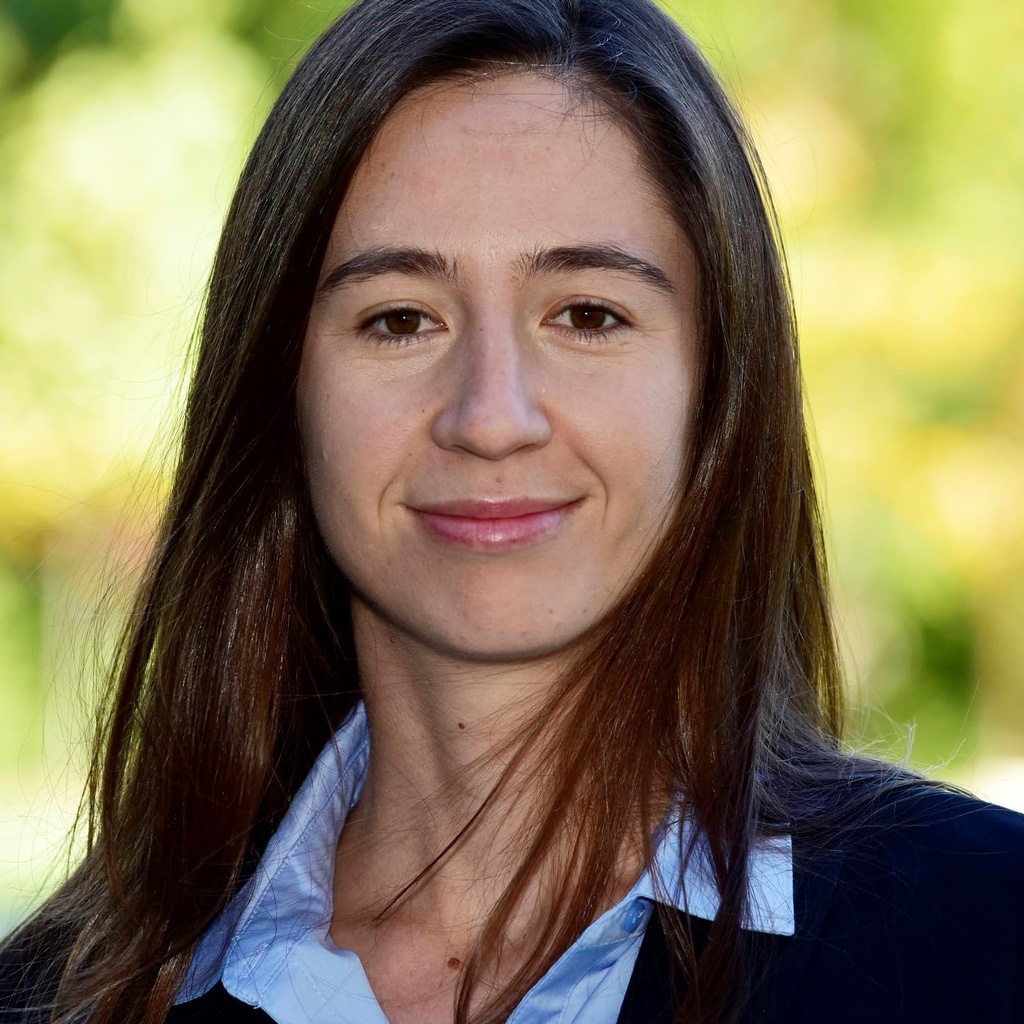
PRESENTER: Dr. Huertas-Cerdeira is an Assistant Professor in the Department of Mechanical Engineering at the University of Maryland, College Park. She has broad research interests in the fields of Unsteady Fluid Mechanics and Fluid-Structure Interactions. Her group leverages a combination of experimental, analytical and data-driven tools to tackle problems ranging from bio-inspired robotics to efficient aviation, wind energy harvesting and heat transfer enhancement. Dr. Huertas-Cerdeira holds a BS and MS in Aeronautics from Universidad Politécnica de Madrid (Spain) and ENSMA (France), respectively. She received her PhD in Aeronautics from the California Institute of Technology in 2019, for which she obtained Caltech’s William F. Ballhaus Prize. She was the recipient of an NSF CAREER award in 2024 and obtained the ASME Rising Starts in Mechanical Engineering Award in 2025.